Three Weeks Into Construction, the Job Stopped
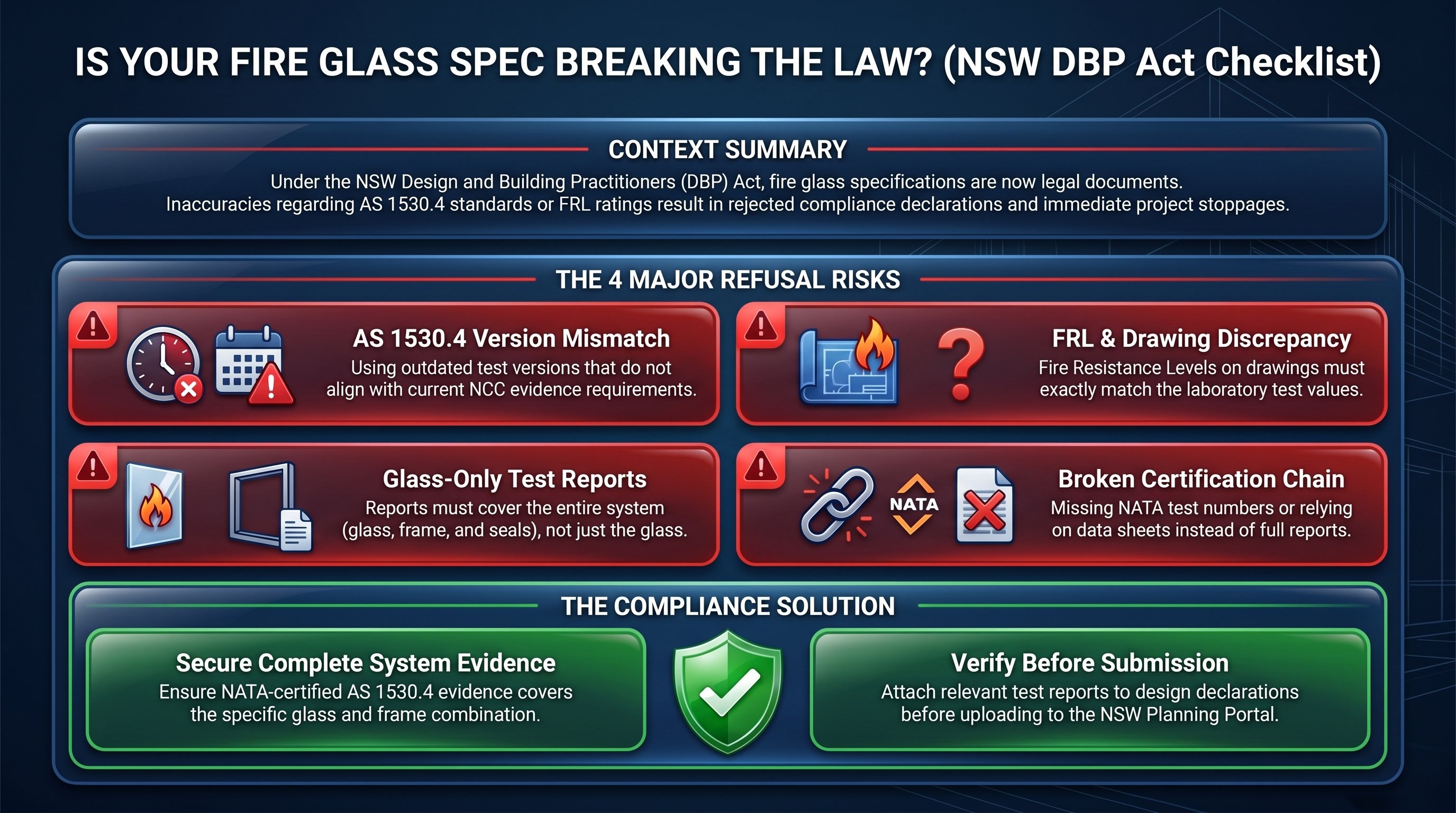
A project architect in Sydney got the call three weeks into construction. The compliance declaration for a Class 2 residential tower had been rejected. The reason: the fire-rated glazing specification cited a test standard whose version no longer matched the edition adopted by the NCC, and the Fire Resistance Level on the drawings didn't align with the lab report for the glass-to-frame assembly.
The job stopped. The builder was furious. The architect was exposed.
That scenario is not an edge case. Under NSW's Design and Building Practitioners Act 2020 (DBP Act), it's the kind of liability that lands on architects and specifiers every week. The Act took effect in July 2021, but its enforcement teeth have sharpened considerably since then. If you're still specifying fire-rated glazing the way you did five years ago, you're carrying risk you may not have priced into the job.
What the DBP Act Actually Says — and Which Buildings It Covers
The DBP Act classifies passive fire systems as regulated building elements. No carve-outs, no exemptions for standard specifications. Fire-rated glass is never just a product selection — it is a passive fire system component subject to the full weight of practitioner declaration requirements.
For architects working on buildings within scope, this triggers a hard requirement: any work that touches fire-rated walls or glazing demands a registered design practitioner's declaration. You are personally signing off that the design complies with the Building Code of Australia. The fire-rated window or door assembly must have been tested to AS 1530.4, and the test report must cover the specific glass-to-frame combination you're specifying. Close enough doesn't count.
Getting the spec right upfront stopped being good practice. It's now a legal obligation — and the scope of buildings caught by this requirement is broader than many architects realize.
| Building Class | Building Type | New Work | Alteration / Renovation |
|---|---|---|---|
| Class 2 | Apartment buildings, mixed-use developments with a Class 2 part | In force | In force |
| Class 3 | Hotels, motels, student accommodation, backpacker hostels | In force from 2023-07-03 | Expected 2026-07-01 |
| Class 9c | Aged care facilities | In force from 2023-07-03 | Expected 2026-07-01 |
Any building containing a Class 2 part — including mixed-use towers with retail or commercial podiums — falls within scope for the residential component. The Act's reach on new Class 3 and 9c work has been active since mid-2023. Alteration and renovation work on those classes is on a clear trajectory toward the July 2026 deadline. Architects working across the hospitality and aged-care sectors need to be preparing their specification workflows now.
The AIA Signal You Shouldn't Ignore
The Australian Institute of Architects does not build a formal CPD series around legislation it expects to go unenforced.
In direct partnership with NSW Fair Trading, the AIA launched a dedicated DBP Act CPD curriculum. Building Commissioner David Chandler — the man driving enforcement of the Act — personally contributed to the series. The peak professional body representing more than 14,000 architects has invested significant educational resources into this single piece of legislation, with the regulator showing up to teach it. The message is unambiguous: the compliance window is closing, and enforcement is now.
The AIA DBP Act CPD series covers practitioner registration, declaration obligations, and what "reasonably compliant design" means under the new framework. Fire-rated glazing intersects with all three modules. Architects who haven't completed the series are operating on old assumptions — and old assumptions are what get declarations rejected.
When the profession's own education arm treats a piece of legislation as a formal CPD priority, and the Building Commissioner participates in the delivery, the industry should read the room. This is not shelf legislation.
Four Ways Your Fire Glass Spec Fails DBP Act Scrutiny
The regulators aren't looking for criminal intent. They're checking paperwork — and paperwork is where fire glazing specifications tend to unravel. Each of these four scenarios stops the project. No partial credit. No "fix it in construction." The declaration gets rejected, and the clock starts ticking on program delays and contractual penalties.
Specify It Right From Design — There Is No Other Option
The practical takeaway is straightforward: fire-rated glazing specification needs to happen at design stage — not during RFI responses, not at shop drawing submission, and certainly not on site when the builder is waiting for a compliance sign-off.
Specifiers who move fire glazing evidence review from the construction phase to the design phase report measurably fewer declaration rejections. The workflow shift is not complex — it's simply a matter of asking for the test report at the same time you ask for the data sheet.
The Compliance Window Is Closing — and the Scope Is Wider Than You Think
The DBP Act is not another piece of shelf legislation. Building Commissioner Chandler has been clear: the grace period for learning the rules is over. Enforcement actions are mounting. Architects and specifiers who treat fire glazing as a deferred compliance item are making a calculated bet — and the odds are getting worse with each quarter.
The AIA has built the curriculum. The Commissioner has delivered the message. More than 14,000 Institute members are on notice. The question now is whether individual practices are following the roadmap — or waiting for a rejected declaration to force the issue.
Architects working on Class 2 projects are already inside the regulatory perimeter. Those working on Class 3 and 9c alterations should be treating the July 2026 trigger date as a design-stage deadline, not a distant horizon. Specification workflows that worked in 2019 will not survive a 2026 compliance review.
DBP Act Compliance Reference for Fire Glazing Specifiers
We've compiled a reference table mapping DBP Act declaration requirements against fire glazing evidence standards — which test reports you need, which certifications hold up, and where the common rejection points are. No pitch, just the framework.
Get the Reference →References
-
NSW Design and Building Practitioners Act 2020 — Full text of the Act, including definitions of regulated building elements and practitioner declaration obligations.
legislation.nsw.gov.au/view/html/inforce/current/act-2020-007 -
NSW Design and Building Practitioners Regulation 2021 — Supporting regulation detailing building classes, compliance declaration requirements, and transitional provisions.
legislation.nsw.gov.au/view/html/inforce/current/sl-2021-0252 -
AIA DBP Act CPD Series — Formal continuing professional development series developed in partnership with NSW Fair Trading, featuring Building Commissioner David Chandler.
architecture.com.au/cpd-education/ -
NSW Office of the Building Commissioner — Official page for Building Commissioner David Chandler, including enforcement updates, practice standards, and regulatory guidance.
nsw.gov.au/fair-trading/building-commissioner -
AS 1530.4:2014 — Methods for fire tests on building materials, components and structures — The fire-resistance test standard referenced by the NCC for passive fire systems including glazed assemblies. Published by Standards Australia.
Standards Australia -
NCC 2025 Volume One — The National Construction Code, containing the deemed-to-satisfy provisions and referenced standards governing fire-rated construction in Class 2–9 buildings.
ncc.abcb.gov.au