Why Your Fire-Rated Window Spec Can't Be Found in WERS — and What It Costs NCC Section J Compliance
Bottom Line
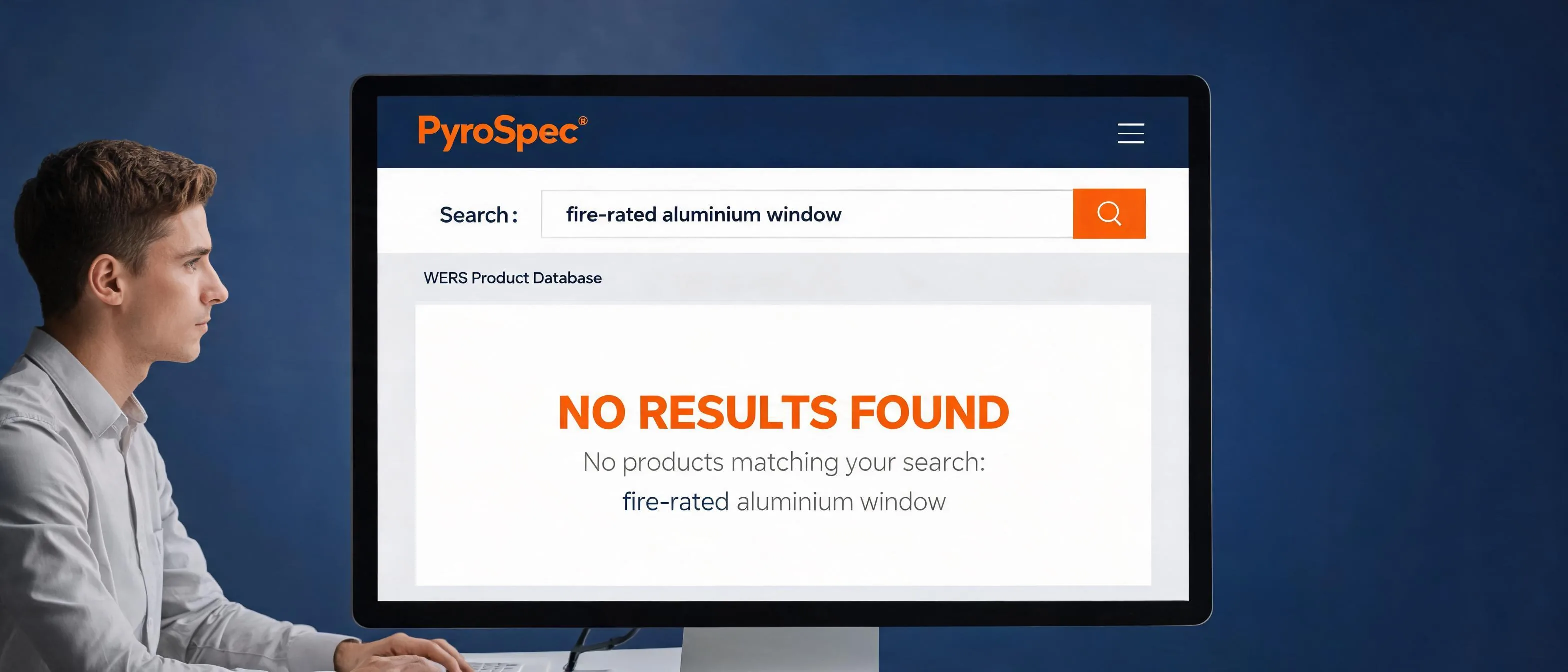
WERS — the Window Energy Rating Scheme, Australia's official window energy performance database — holds 71,714 product listings from 146 manufacturers. Exactly five of those listings are fire-rated. All five come from a single manufacturer: NilFire. All five are steel-framed. If your project requires an aluminium-framed fire-rated window with a WERS energy rating — for NCC Section J compliance, VEU rebates, or Green Star certification — you are searching for something that does not exist in the database. This gap forces energy assessors to apply a default U-value of 5.8 to every fire-rated glazing opening. On a commercial project with 180 fire-rated windows, that default assumption can mean the difference between Section J compliance and a failed energy assessment — pushing the project into costly alternative JV3 modelling or triggering a re-specification cycle that delays the construction certificate by weeks.
The Search Problem: WERS Has No 'Fire-Rated' Filter
WERS operates a four-module search interface — Residential, Commercial, Skylights, Films — with filters for frame material, glass specification, and operation type. There is no checkbox, no tag, no keyword field for "fire-rated." An architect searching for a fire-rated window with verified energy data cannot filter for it. They must either know which glass brands are fire-rated (Pyrodur, Pyrostop) and search by brand, or know the one manufacturer (NilFire) and search by company name. Neither approach helps a specifier who simply needs to find compliant options.
This matters because WERS is the pathway to compliance for multiple regulatory frameworks. The Victorian Energy Upgrades (VEU) rebate program ties eligibility to WERS star ratings. Green Star requires verified energy data. NCC Section J defaults to the worst case if no WERS data exists.
When an energy assessor encounters a fire-rated glazing opening with no WERS data, NCC 2025 J4D6 requires them to apply a default Total System U-Value of 5.8. A DG fire-rated IGU with Low-E coating might achieve a real U-value of 2.8. That 3.0 point gap — applied across every fire-rated opening in the building — can push the whole facade assembly below the required energy rating threshold. The building passes fire compliance but fails energy compliance. Both are mandatory.
What WERS Certification Actually Requires
A product entering WERS must supply 11 data fields, including U-value, SHGC, visible light transmittance, and air infiltration — all from a NATA-accredited laboratory. For fire-rated glass, this means the manufacturer must hold both AS 1530.4 fire test reports and NATA energy performance test reports for the same glass-plus-frame assembly.
The certification process involves five stages: AGWA membership application, NATA lab testing, submission through the AGWA WERS portal, review and publication on werslink.com.au, and ongoing maintenance with daily data refreshes. The dual testing requirement — fire resistance plus thermal performance — is the structural reason why only one manufacturer has completed the process.
| Certification Stage | What's Required | Typical Timeline |
|---|---|---|
| 1. AGWA Membership | Annual fee ~$1,500-$3,000 | 2-4 weeks |
| 2. NATA Lab Testing | Fire (AS 1530.4) + Energy (U-value, SHGC) | 8-16 weeks |
| 3. WERS Submission | 11 data fields + test reports | 1-2 weeks |
| 4. Review & Publication | AGWA/WERS team audit | 2-4 weeks |
| 5. Ongoing Maintenance | Daily data sync, annual renewal | Ongoing |
The Aluminium Frame Gap
NilFire's five WERS-listed products all use steel frames. In zones 3-5 — covering Perth, Adelaide, Melbourne, Sydney, and Brisbane, the most populated climate zones in Australia — aluminium frames with thermal breaks outperform steel on energy metrics. An aluminium-framed fire-rated window with a DG Low-E IGU could deliver a U-value of 2.5-3.2 with 5.0+ Heating Stars. That configuration would clear VEU rebate thresholds, NCC Section J compliance, and Green Star requirements in a single product.
This product does not exist in WERS today. A manufacturer that registers it gains a monopoly on an entire product category — the aluminium-framed fire-rated window with verified WERS energy data.
What This Costs on a Real Project
Consider a mid-rise commercial project in Melbourne (Climate Zone 5) with approximately 180 fire-rated glazing openings — a realistic count for a 12-storey office building with fire-isolated stairwells, protected corridors, and service riser enclosures.
| Scenario | U-Value Applied | Section J Result | Consequence |
|---|---|---|---|
| No WERS data | 5.8 (default) | Likely fail | JV3 modelling or redesign required |
| SG fire-rated, WERS-certified | 5.4 | Marginal | May pass in mild zones, fail in Zones 5-8 |
| DG fire-rated IGU, WERS-certified | 3.2-4.0 | Compliant | Clears J4D6 in most zones |
| DG fire-rated + Low-E, WERS-certified | 2.5-3.2 | Easily compliant | Clears J4D6 + VEU + Green Star |
The difference between "no WERS data" and a DG+Low-E WERS-certified product is a factor of two on U-value. Spread across 180 openings, that gap can change the building's whole-of-facade energy rating by 10-15 points.
Three Things Specifiers Can Do Now
- Check whether your fire-rated window supplier holds WERS data. If they don't, your energy assessor will apply the 5.8 default — and your Section J report will reflect that penalty across every fire-rated opening.
- Request combined fire + energy test evidence. A supplier with only an AS 1530.4 report and no WERS data is handing you half a compliance package. NCC requires both Section C and Section J to pass. Both need verifiable numbers.
- Specify aluminium frames for Zones 3-5. If your project is in Sydney, Melbourne, Brisbane, Adelaide, or Perth — where the majority of Australian commercial construction happens — steel-framed fire-rated windows will underperform on energy. An aluminium option with WERS data gives you a compliance margin that steel cannot match.
Need Fire-Rated Glazing with Verified Energy Data?
We provide AS 1530.4 test reports and energy performance documentation in a single compliance pack. For specifiers preparing NCC Section J submissions, we can supply provisional U-value and SHGC data for DG fire-rated IGU configurations before WERS registration is complete.
Request Energy Data →Sources & References
- AGWA — WERS Public Database (werslink.com.au) — data accessed May 29, 2026
- AGWA — WERS Certification Page
- Australian Building Codes Board — NCC 2025 Volume One, Section J
- GBCA — Green Star Buildings v1.1
- Essential Services Commission Victoria — VEU Program Guidelines
- Master Builders Australia — Pre-Budget Submission Dec 2025 — NCC compliance burden analysis