Australia's First Government-Backed Fire-Rated Glass Facility Has Opened. The Procurement Shift Is Already Here.
Key Takeaways
- Northern Glass Solutions opened its $21 million purpose-built glass manufacturing facility at East Arm, Darwin in early 2026, supported by the NT Government's Advanced Manufacturing Ecosystem Fund administered by AMGC.
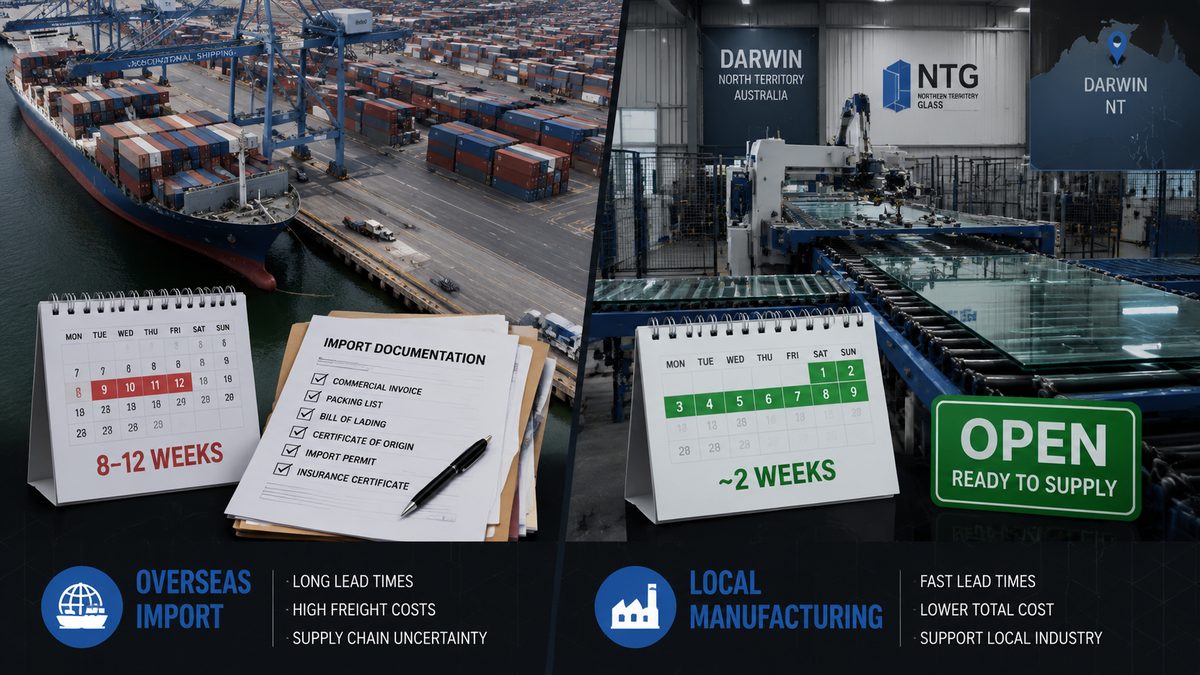
- The project's stated rationale is to address "a yawning gap in the local market" and reduce reliance on imported glass products, according to AMGC's Northern Territory Director. That is not a market-complement strategy. It is a displacement strategy.
- One production line will not replace imported fire-rated glass supply chains into Sydney, Melbourne, or Brisbane. But it resets lead time expectations and establishes a visible domestic price benchmark for the first time.
- Importers with complete AS 1530.4 documentation packs, NATA-accredited test evidence, and engineer-level technical response capability are structurally differentiated. Price-only competitors on standard EI60/EI120 panels face the greatest exposure.
The funding signal — and what it actually means
Australian construction remained in contraction through early 2026, with the Ai Group Industry Index for construction averaging around -8 points across February 2026, with firms citing elevated costs, energy prices, tight cashflow, and persistent skills shortages.
Against that backdrop, the NT Government and AMGC put public money into a domestic fire-rated glass facility. The $5.4 million project, supported by a $668,072 co-investment from the NT Government's Advanced Manufacturing Ecosystem Fund (AMEF) administered by AMGC, links Northern Glass Solutions with the Australian Glass & Window Association, James Cook University, and RMIT University for R&D, testing, and manufacturing capability.
The facility — a purpose-built, automated manufacturing plant at East Arm Darwin — was officially opened in early 2026. The project's total investment reached $21 million, with the plant designed to improve supply chain resilience by bringing specialty glass production approximately 3,000 kilometres closer to Territory markets.
NGS estimates $12.6 million in new revenues and 22 jobs within five years.
The partner structure is what matters most for procurement analysis. AGWA provides industry legitimacy and specifier reach. James Cook University and RMIT bring research and development pipeline credibility. These are not cosmetic associations — they are embedded from project inception.
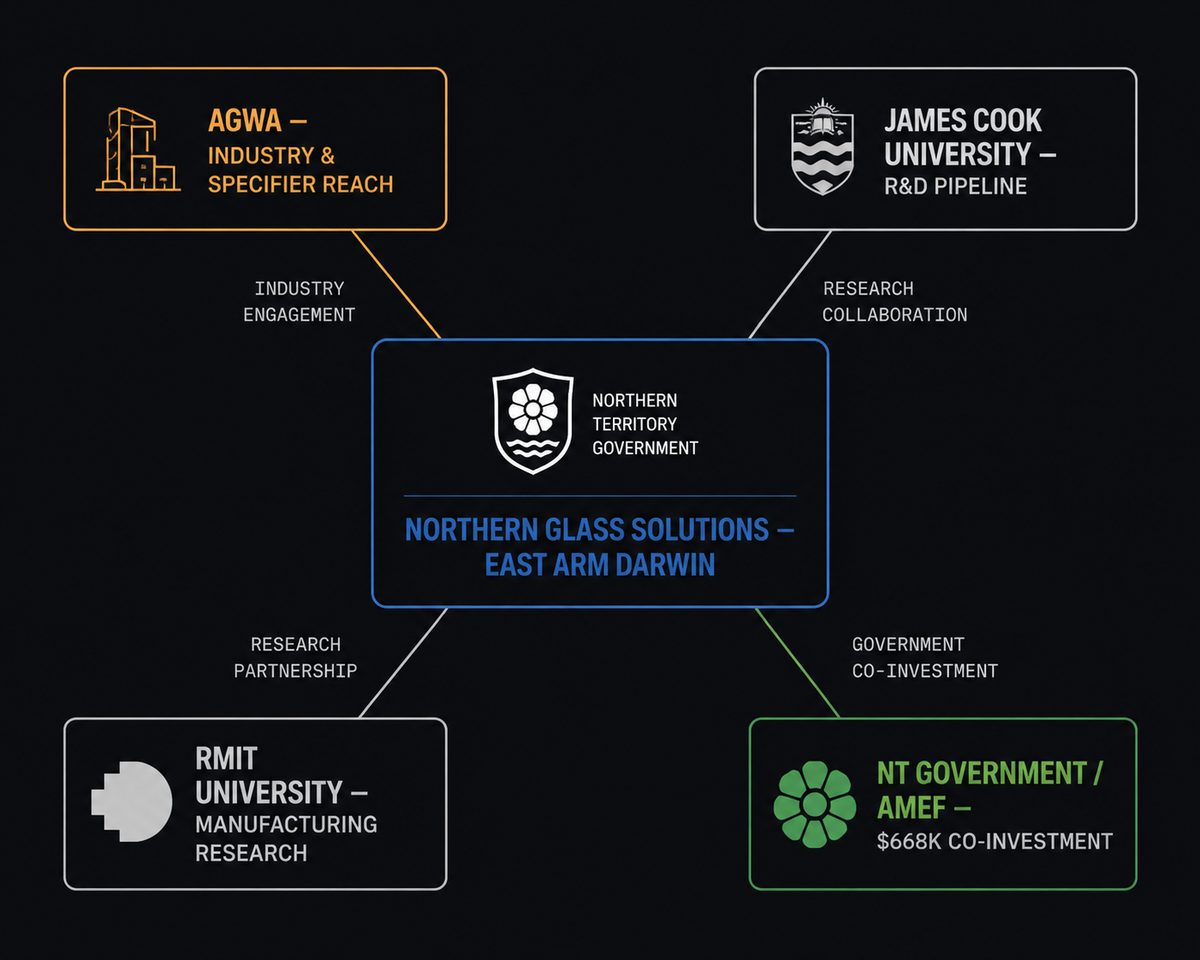
Northern Glass Solutions opened a $21 million purpose-built automated glass manufacturing facility at East Arm, Darwin in early 2026, supported by the NT Government's Advanced Manufacturing Ecosystem Fund administered by AMGC. Production capabilities include fire-resistant, triple- and quadruple-glazed, laminated, tempered, acoustic, cyclone-resistant, and safety glass. — AMGC / Australian Manufacturing, March 2026
What the NGS facility actually produces
Northern Glass Solutions has commissioned a purpose-built processing plant at Darwin East Arm Business Park, designed for scale, efficiency, and future growth. The open-plan facility sits on 10,000 square metres of land, with 6,300 square metres under cover.
In an eight-hour shift, NGS can cut and toughen approximately 1,000 square metres of glass — enough to supply 20 houses — and produce 350 square metres of double-glazing.
Product categories from the facility include:
- Fire-resistant glass — directly relevant to AS 1530.4 compliance pathways
- Triple- and quadruple-glazed units
- Laminated and tempered glass
- Acoustic glass
- Cyclone-resistant and safety glass
| Source | Amount |
|---|---|
| NT Government co-investment (AMEF via AMGC) | $668,072 |
| Industry contribution | $668,072 |
| In-kind (partner contributions) | $4,090,000 |
| Total project phase (AMGC) | $5,426,000 |
| Total facility investment | $21,000,000 |
Source: AMGC project portfolio, August 2025 / Australian Manufacturing, March 2026
The facility also holds export potential, with opportunities to supply markets in the Pacific Islands and Southeast Asia.
What changes in procurement — and what does not
One factory with one production line does not replace Australia's imported fire-rated glass supply. Tier 1 and Tier 2 projects from Sydney to Brisbane to Perth consume thousands of square metres of fire-rated glazing annually. NGS will supplement, not replace.
What changes is the frame of comparison.
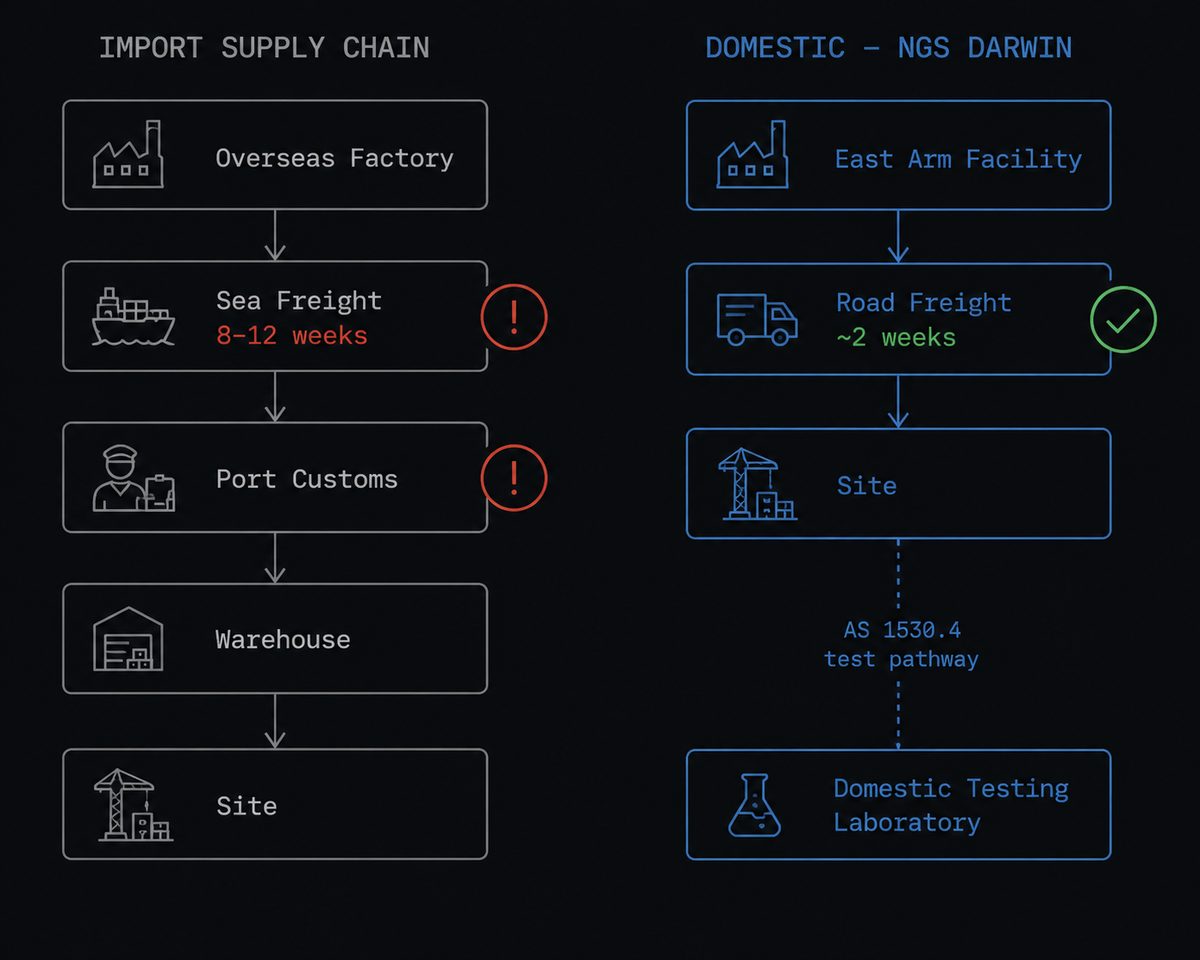
| Dimension | Current (Import) | Emerging (Domestic, NGS) |
|---|---|---|
| Lead time | 8–12 weeks (sea freight) | ~2 weeks (local logistics) |
| Compliance trail | Overseas test reports + NCC mapping | Domestic production, local testing pathways |
| Price benchmark | FX + freight + duty, no domestic reference | Visible domestic price baseline |
| Specifier confidence | Depends entirely on documentation quality | Known NT Government-backed facility |
| Supply volume | High (multiple overseas production lines) | Moderate (single facility, single location) |
| Transit damage risk | Moderate to high (sea freight) | Minimal (domestic logistics) |
| Programme flexibility | Constrained by shipping schedules | Responsive to local demand cycles |
| Geographic reach | National distribution established | Currently strongest in NT, Northern Australia |
Lead time and pricing figures are indicative industry benchmarks. Compliance trail reflects general procurement practice, not individual supplier capabilities. Source: AMGC project data, industry procurement benchmarks.
Three procurement dynamics shift:
- Lead time expectations. When a local alternative delivers in approximately two weeks, an eight-to-twelve-week import lead time requires active justification in tender evaluations — not just acceptance as the default.
- Compliance documentation pathway. A facility producing glass domestically can engage directly with Australian testing laboratories without cross-recognition mapping of overseas test reports. When a certifier requests additional AS 1530.4 evidence mid-project, the question of laboratory recognition is simpler with domestic production.
- Price anchoring. A domestically visible price benchmark changes how import quotes are evaluated. Import pricing that previously competed only against other import quotes will now be measured against a local baseline, however limited the initial domestic production volume.
Where importers maintain structural advantage
The NGS facility validates the fire-rated glazing category for the Australian market. It signals to builders, certifiers, and developers that fire-rated glass is a technologically mature, investable manufacturing segment — not a permanent import dependency.
Importers in the strongest position share three characteristics:
- Pre-prepared AS 1530.4 documentation packs. Not assembling test reports after the tender is awarded. Complete evidence-of-suitability documentation mapped to NCC A5G3(d), covering the complete tested assembly — glass, frame, and seals — ready for certifier review on day one of the project.
- Reliable lead time communication in programme language. Not quoting "8 to 12 weeks" and hoping. Tracking production milestones, flagging delays before the builder asks, and communicating in programme language, not supplier language.
- Technical RFI response capability. When a certifier or façade engineer asks for field-of-direct-application limits, interlayer specifications, or frame-compatibility data, the answer returns in engineering language within hours — not brochure language within days.
The suppliers who lose ground are those competing on unit price alone for standard EI60 and EI120 panels, supplying with incomplete documentation, and becoming difficult to reach when technical questions arise. That segment was already under margin pressure before the NGS facility opened. Domestic production accelerates the exposure — it does not create it.
A domestic fire-rated glass facility in Darwin validates the category for Australian builders, certifiers, and specifiers. Importers with complete AS 1530.4 assembly documentation mapped to NCC A5G3(d), reliable lead time communication, and technical RFI response capability operate in a different procurement segment from standard-panel commodity supply. The domestic facility increases pressure on price-only competitors; it strengthens the position of documentation-led suppliers. — PyroSpec Glass technical analysis, June 2026
Three questions procurement teams should ask now
If you specify or procure fire-rated glass for Australian projects in the next 12 to 24 months:
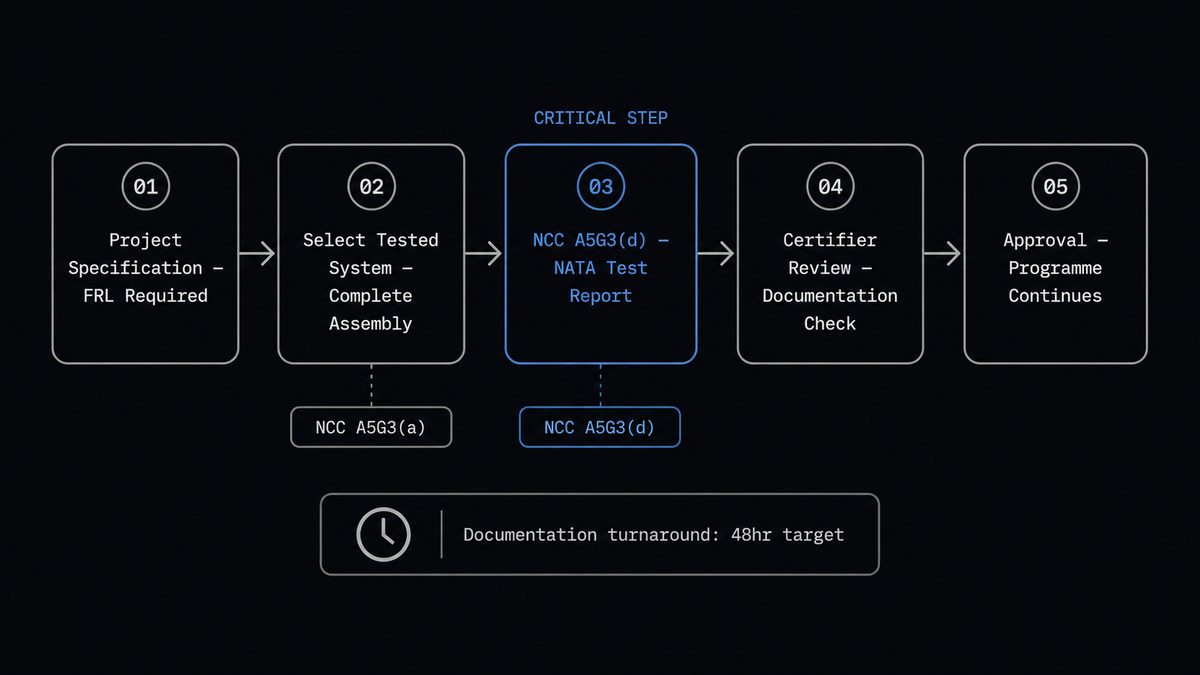
- Documentation turnaround. If a certifier requests additional AS 1530.4 test evidence mid-project, can your current supplier deliver a complete assembly evidence pack within 48 hours — or will the programme wait weeks?
- Dual-source strategy. Are you building supplier relationships across both domestic and international sources, or concentrated on one? A single point of failure in fire-rated glazing supply creates programme risk no builder absorbs willingly.
- Lead time contingency. Does your supplier have a documented plan for demand spikes — or are lead time promises aspirational rather than operational?
Need Fire-Rated Glass for an Australian Project?
PyroSpec Glass supplies AS 1530.4-compliant fire-rated glazing systems with complete documentation packs, NCC compliance pathway support mapped to A5G3(d), and engineer-level technical response. The NGS facility raises the floor for Australian fire-rated glass procurement. Our documentation and lead time reliability keep you above it.
Contact Technical Team — Request a project compliance review →
Download Documentation — AS 1530.4 test report summary and NCC compliance pathway guide →
Sources
- AMGC media release, 20 August 2025
- Australian Manufacturing, 20 August 2025 & 4 March 2026
- Territory Q, March 2026
- Ai Group Industry Index Construction, February 2026
- AMGC project portfolio
- AS 1530.4:2014
- NCC 2025 A5G3(d)